

Canada's food sector faces significant affordability pressures in 2026, driven by rising prices, supply chain challenges, and changing consumer behaviour as households struggle with cost-of-living increases.
Food Price Increases and Household Impact
Food prices are projected to increase by 4-6% in 2026, with the average family of four expected to spend up to $17,571.79 on groceries—an increase of up to $994.63 from 2025. This continues a longer-term trend: food prices are now 27% higher than they were five years ago, and since 2020, food prices have risen faster than overall inflation, costing the average household $782.
Multiple factors are driving these increases. Global weather events, consumer behaviours, changes in retail business models, and the inflationary impacts of tariffs are cited as major driving factors. Additionally, labour shortages resulting from Temporary Foreign Worker Program reforms could increase costs for businesses already operating on tight margins, with those extra costs potentially passed on to consumers.
Consumer Behaviour Shifts
Canadians are responding to affordability pressures by significantly reducing their food spending and dining out. In a 2025 survey, 75% of Canadians reported reducing their restaurant visits due to cost-of-living increases. Restaurant visits fell to their lowest level of the year in December 2025, with affordability pressures cited by 42% of Canadians as the main barrier to dining out.
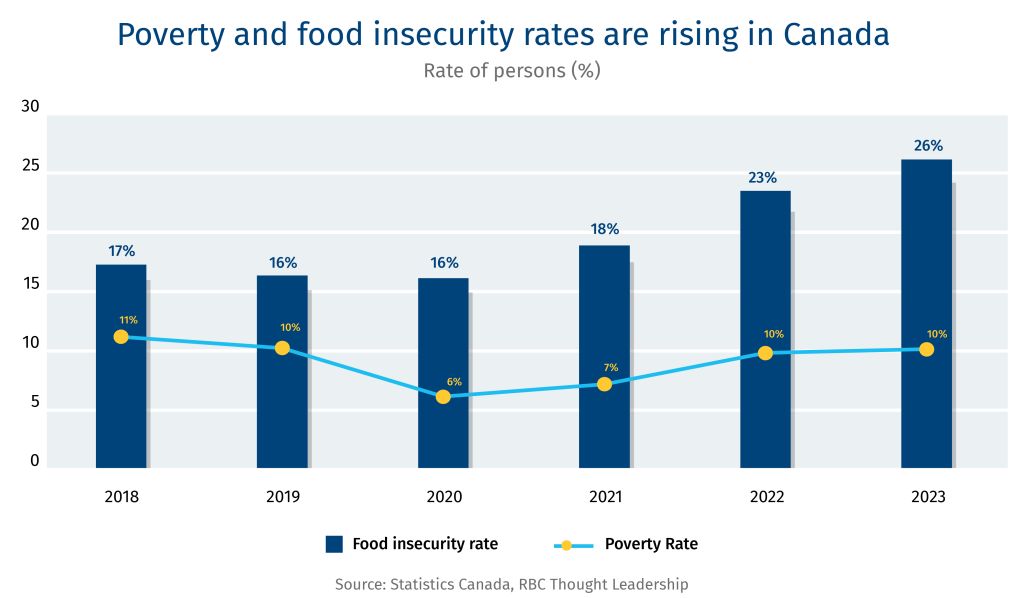
Consumers are also making difficult trade-offs at the grocery store, ranging from switching to cheaper brands to delaying purchases altogether. Food insecurity and nutritional security concerns are growing, as families struggle to afford healthy diets.
Government Response Measures
To address these challenges, the federal government has introduced the Canada Groceries and Essentials Benefit, which received Royal Assent in February 2026. This program will provide relief to more than 12 million low- and modest-income Canadians starting in spring 2026.
The benefit includes:
- A one-time 50% top-up payment in 2026, with the government targeting June 2026 to begin issuing payments
- A 25% increase to the benefit for five years beginning in July 2026
Financial support levels are as follows: a family of four will receive up to $1,890 in 2026 and approximately $1,400 annually for the next four years; a single person will receive up to $950 in 2026 and about $700 annually thereafter.
Beyond direct payments, the government is also addressing supply chain issues by setting aside $500 million from the Strategic Response Fund to help businesses address supply chain disruption costs without passing them to consumers, and creating a $150 million Food Security Fund for small and medium enterprises. Additionally, $20 million is being provided to the Local Food Infrastructure Fund to support food banks and other organizations delivering nutritious food to families in need.
Long-Term Structural Challenges
While these immediate measures provide relief, the food sector faces deeper structural challenges. The restaurant industry notes that the enhanced GST credit, while helpful, does not address fundamental industry challenges, and continues advocating for exempting all food from GST. Experts emphasize that tackling high food costs requires addressing fixed factors such as rent and wages that strain consumers' budgets beyond food prices alone.













Maple Ranking offers the highest quality website traffic services in Canada. We provide a variety of traffic services for our clients, including website traffic, desktop traffic, mobile traffic, Google traffic, search traffic, eCommerce traffic, YouTube traffic, and TikTok traffic. Our website boasts a 100% customer satisfaction rate, so you can confidently purchase large amounts of SEO traffic online. For just 720 PHP per month, you can immediately increase website traffic, improve SEO performance, and boost sales!
Having trouble choosing a traffic package? Contact us, and our staff will assist you.
Free consultation