

Recovering from guest-posting-related link penalties requires auditing your backlinks, removing or disavowing low-quality guest post links, documenting your cleanup, and then waiting (or submitting a reconsideration request if it’s a manual action) while building higher-quality, editorial links going forward.
Below is a focused, practical process tailored to guest posting penalties and low-quality links.
1. Confirm it’s a link / guest posting issue
-
Check Google Search Console (GSC) → Manual Actions
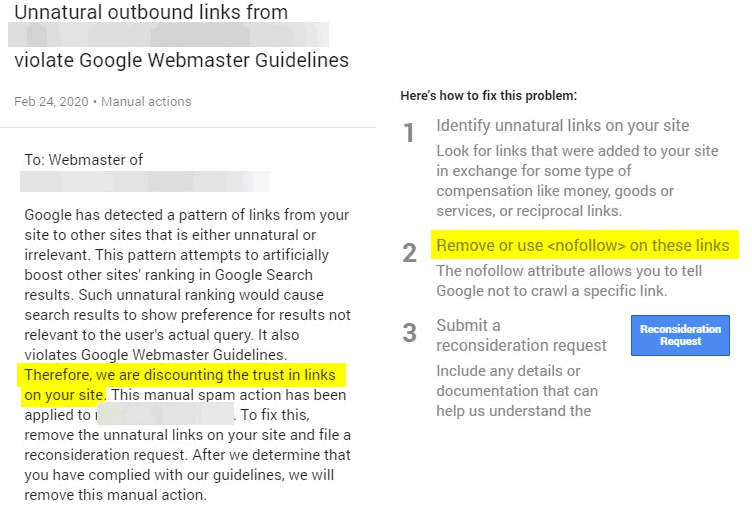
- If you see something like “Unnatural links to your site” or “Spammy links”, you have a manual link penalty.
- If there is no manual action, but you see a sharp drop after a known update targeting spam/links, you may be affected algorithmically (e.g., Penguin-like link signals).
-
Correlate traffic & ranking drops
- Use Analytics + GSC performance reports to see when traffic and rankings fell.
- Map that date to any known link/spam updates discussed in SEO news (helpful for diagnosing algorithmic demotions).
2. Build a complete backlink list
Use multiple sources to avoid missing toxic guest post links:
- Google Search Console → Links → Top linking sites (export).
- Third‑party tools (Ahrefs, Majestic, SEMrush, etc.) for deeper coverage.
- Merge and deduplicate into one master sheet (URL of linking page, linking domain, anchor text, target URL, type: guest post, directory, etc.).
3. Identify low-quality guest post links
Flag patterns typical of penalized guest posting:
- “Write for us” farms / MBG (My Blog Guest–style) networks with:
- Thin, generic content, spun or templated articles.
- Obvious SEO anchors (exact-match money keywords) in author bio/body.
- Dozens of outbound links to unrelated sites.
- Irrelevant niches: e.g., a casino link on a parenting blog.
- PBN-like or spam domains:
- Nonsense brand names, no real “about” or contact page.
- Over-optimised category/tag pages, sitewide external links.
- Duplicate or syndicated guest posts across multiple sites with similar content.
- Non-indexed or deindexed linking pages/domains (site: search returns nothing; often a bad signal).
Create simple labels per link:
- “Toxic guest post” – clear violation / obviously manipulative.
- “Suspicious guest post” – borderline; may keep if cleaned (e.g., remove keyword anchor).
- “Natural / OK” – high-quality, editorial, relevant article with brand/URL anchor and genuine value.
4. Clean up low-quality guest post links
4.1 Try to remove links first
Google expects real removal efforts before disavow for manual actions.
- Contact webmasters:
- Request link removal or switch to a nofollow/sponsored attribute.
- If the whole guest post is clearly spammy, ask them to delete the page.
- Track outreach:
- Date contacted, method, response, outcome.
Prioritise:
- Sites/networks obviously created for link selling.
- Pages with over-optimised money anchors.
- Irrelevant niches or non-indexed domains.
4.2 Use the Disavow Tool for the rest
When removals fail or hosts don’t respond:
- Prepare a domain-level disavow for obvious spammy / PBN / MBG domains, not just single URLs.
- Include only links you’re confident are toxic; over‑disavowing can slow recovery.
- Upload via GSC Disavow Tool for the correct property.
5. Fix on-site guest posting & UGC issues
If you accept guest posts or user content on your own site, clean that up too.
- Remove or rewrite low‑quality guest posts on your domain:
- Delete thin, duplicate, or irrelevant guest articles.
- Where content is decent but links are spammy, edit links/anchors to be natural or remove them.
- Apply rel="nofollow" or rel="sponsored" to outbound links that are paid, contributed, or SEO-driven.
- Strengthen moderation:
- Manual review of all future guest posts.
- Clear editorial guidelines: expertise, originality, real authors.
- No keyword anchors; only branded/URL or truly natural anchors.
- For comments/forums, remove spammy UGC and enforce strict moderation/captcha.
This shows Google you have addressed the root cause, not just current links.
6. Document everything
Keep a simple log (sheet or doc):
- Audit methodology (tools used, criteria for toxic links).
- List of removed links (with evidence where possible).
- Outreach attempts: screenshots, email copies.
- Disavow file versions and dates.
- On-site actions (guest posts removed/rewritten, nofollow policies, new guidelines).
This documentation is crucial for reconsideration requests and for your own tracking.
7. Reconsideration request (manual actions only)
If you had a manual action in GSC:
-
Fix first, request later – submit only after:
- Toxic guest post links are largely removed or disavowed.
- Your own guest post policy and content are cleaned up.
-
In the request, be specific and honest:
- What caused the issue:
- “We engaged in large-scale guest posting for links / used MBG-style platforms / paid for links in guest posts.”
- What you have done:
- X domains contacted, Y links removed, disavow file uploaded with Z domains.
- On-site guest posts deleted or updated, outbound links nofollowed, new editorial guidelines implemented.
- How you will prevent it:
- No more paid/automated guest posting.
- Only editorial, relevant, brand-focused mentions; strict guest-post policy.
- What caused the issue:
-
Expect several days to weeks or more for review; link-related cases can take longer.
8. For algorithmic penalties (no manual action)
-
There is no reconsideration form. The process is:
- Audit and cleanup links (removal + disavow) as above.
- Improve site-wide quality:
- Remove/upgrade thin content, consolidate overlapping pages, increase topical depth.
- Wait for Google to recrawl/reprocess your link graph and pages. This may take weeks to a few months depending on crawl rate and the scale of issues.
9. Rebuild with safer, long-term link practices
To avoid returning to low-quality guest posting:
- Focus on editorial links:
- In-depth resources, research, tools, or case studies others cite voluntarily.
- PR, interviews, podcasts, expert roundups where the content is the reason for the link.
- If you still do guest posting:
- Only on high-quality, relevant sites with real audiences.
- Avoid networks, link swaps, or “post for fee” schemes.
- Use brand/URL anchors, not repetitive exact-match keywords.
- Be fine with nofollow/sponsored; the primary goal should be exposure and authority, not PageRank.
- Monitor your link profile regularly with GSC and tools, and address new suspicious links promptly.
If you share:
- Whether you see a manual action in GSC,
- Example guest post URLs and anchors,
I can help you design a concrete removal/disavow plan and draft reconsideration wording tailored to your situation.














Maple Ranking offers the highest quality website traffic services in Canada. We provide a variety of traffic services for our clients, including website traffic, desktop traffic, mobile traffic, Google traffic, search traffic, eCommerce traffic, YouTube traffic, and TikTok traffic. Our website boasts a 100% customer satisfaction rate, so you can confidently purchase large amounts of SEO traffic online. For just 720 PHP per month, you can immediately increase website traffic, improve SEO performance, and boost sales!
Having trouble choosing a traffic package? Contact us, and our staff will assist you.
Free consultation