

You measure guest posting ROI by tying each post to specific business goals, then tracking a focused set of traffic, SEO, conversion, and brand metrics over time, and comparing results to your costs. You should not rely on any single metric; ROI emerges from how these metrics work together.
Below is a concise, practical framework you can plug into your analytics.
1. Start with a clear ROI formula
Define what “return” means for your business first (leads, trials, sales, SEO gains, or brand reach).
Typical formulas:
-
Direct revenue ROI (for lead‑gen / sales): [ \text{ROI} = \frac{\text{Revenue attributed to guest posts} - \text{Total guest post cost}}{\text{Total guest post cost}} ]
-
Cost per result (when revenue is harder to attribute):
- Cost per lead (CPL) = total guest posting cost ÷ leads from guest posts
- Cost per new customer (CAC) = total guest posting cost ÷ customers from guest posts
Include:
- Writing/editing costs
- Outreach / placement fees
- Internal time
2. Core traffic & behaviour metrics (top of funnel)
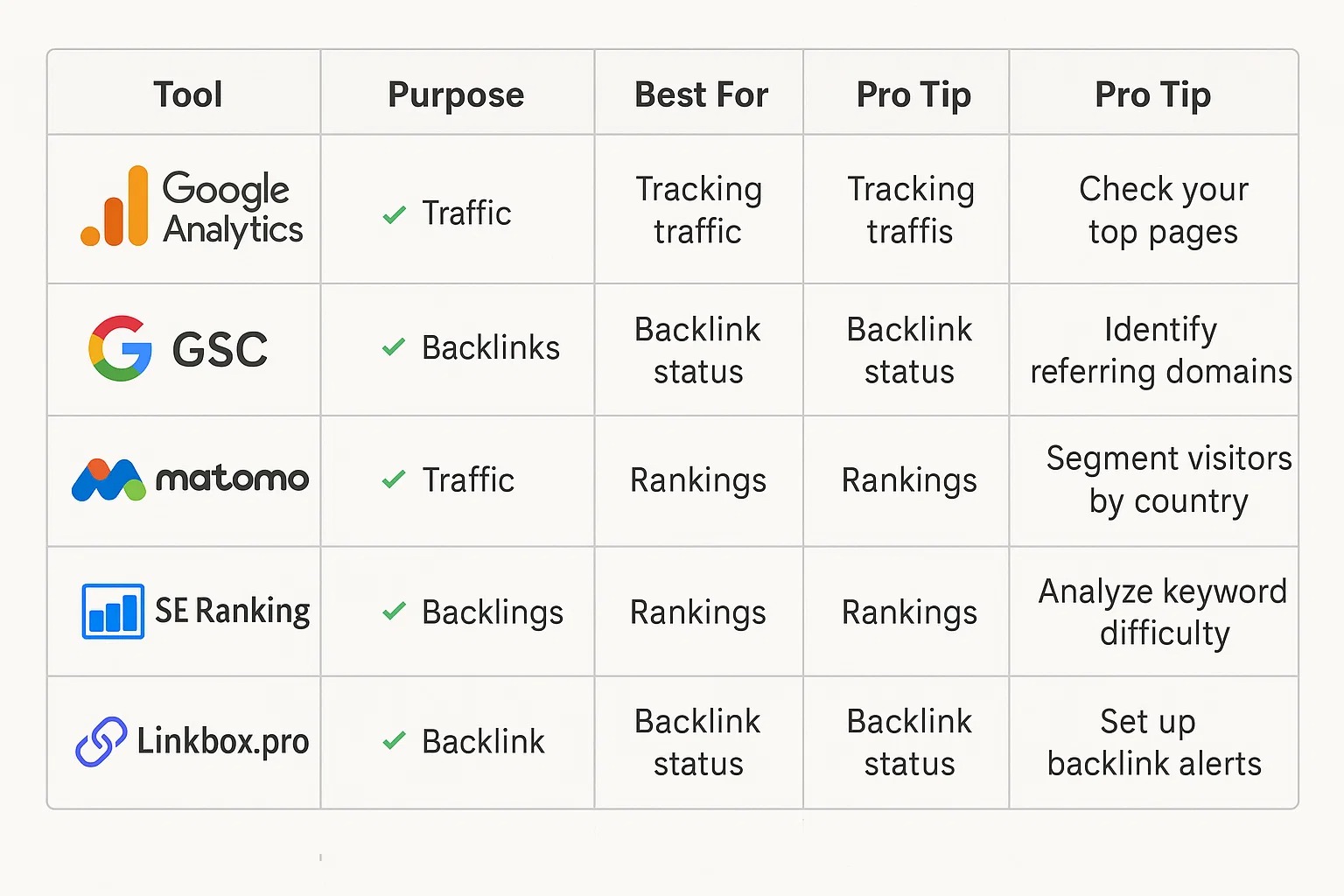
Use Google Analytics (or similar) to track referral traffic from each guest post.
Key metrics:
-
Sessions / users from each post
- Filter by Referrals or use UTM tags to isolate traffic from each article.
- Compare guest post traffic to overall site traffic to gauge impact.
-
Bounce rate
- High bounce can signal mismatch between guest post promise and your landing page, or poor targeting.
- Target: many guides suggest < 65% for guest post traffic as a reasonable benchmark.
-
Pages per session & average time on site
- Indicates how engaged and relevant the traffic is.
- Longer sessions and more pages suggest higher intent and better fit.
These tell you quantity and quality of attention, but not yet business value.
3. Conversion metrics (middle & bottom of funnel)
Set up goals and/or ecommerce tracking to measure what matters after the click.
Track, per guest post source:
-
Conversion rate
- % of visitors who complete a desired action (lead form, newsletter signup, free trial, demo request, purchase, etc.).
- Compare conversion rate of guest post traffic vs. site average to see if it brings higher‑intent users.
-
Number of leads / sign‑ups / sales from each post
- Attribute via:
- Referrals / UTM parameters in Analytics
- CRM source fields
- Some practitioners aim for 2–3% conversion from guest post traffic to leads as a benchmark, though your baseline matters.
- Attribute via:
-
Lead quality
- Down‑funnel signals: SQL rate, opportunities, revenue per lead, churn.
- This is crucial: 100 low‑quality leads are worth less than 10 that close.
These metrics map guest posting to revenue and pipeline, the clearest form of ROI.
4. SEO & long‑term value metrics
Guest posting often delivers delayed SEO ROI beyond immediate traffic.
Track:
-
Keyword ranking improvement
- Did the linked “money page” move up in SERPs for its target keywords after acquiring the guest post link?
- Monitor weekly or monthly; this is a primary SEO KPI.
-
Backlink quality & authority
- Domain authority/DR of the referring site and page.
- New backlinks from other sites that discovered you via the guest post.
-
Organic traffic growth to linked pages
- Use Search Console or analytics to watch organic sessions to the target pages over time.
SEO gains increase indirect ROI by lifting all organic performance, not just referrals.
5. Engagement & brand metrics
Guest posting also builds brand, authority, and network, which influence long‑term ROI.
Track:
-
On‑page engagement on the host site
- Comments, meaningful discussion, questions.
- Compare engagement on your post vs. other posts on that blog.
-
Social engagement
- Shares, likes, comments, reposts of the guest article.
- Indicates reach and resonance, even if it doesn’t convert immediately.
-
Brand mentions
- Mentions of your brand or name across the web that can be traced back to the exposure from a guest post.
-
New subscribers / followers
- Spikes in newsletter signups, social followers, or community members after a post goes live.
-
Industry network growth
- New partnerships, podcast invites, co‑marketing, or speaking requests that originate from the post.
These are softer, but they support future conversions and sales.
6. Turning metrics into ROI analytics
To go beyond raw numbers, build a simple per‑post performance model:
For each guest post (identified via UTM or ref URL), track over a set window (e.g., 90–180 days):
-
Inputs (Cost)
- Content production + outreach + fees.
-
Direct outcomes
- Referral sessions
- Conversions (leads, sign‑ups, sales) and revenue
- Conversion rate
-
SEO outcomes
- Ranking changes for linked pages
- Change in organic traffic and organic conversions tied to those pages.
-
Brand outcomes
- Engagement, shares, mentions, list growth, partnerships.
Then:
- Calculate direct ROI from attributable revenue.
- Estimate SEO ROI by comparing organic uplift vs. previous period for those pages.
- Rank posts by:
- Cost per lead / customer
- Total revenue generated
- Long‑term organic impact
This lets you double down on:
- Topics that convert best
- Sites that send high‑quality traffic
- Content formats / CTAs that outperform
7. Recommended “minimal KPI set” for most teams
To avoid data overload, many experts recommend focusing on about five KPIs across a campaign.
For guest posting, a strong, lean set is:
- Referral sessions per guest post
- Conversion rate from guest post traffic
- Leads / revenue attributed to guest posts
- Keyword ranking improvement for linked pages
- Bounce rate / engagement quality of guest post traffic
You can then layer on social engagement and brand mentions if brand building is a primary goal.
If you tell me your main objective (SEO vs. leads vs. sales vs. brand) and your analytics stack, I can outline a concrete tracking setup (including UTM structures, key reports, and a simple ROI spreadsheet template) tailored to your situation.















Maple Ranking offers the highest quality website traffic services in Canada. We provide a variety of traffic services for our clients, including website traffic, desktop traffic, mobile traffic, Google traffic, search traffic, eCommerce traffic, YouTube traffic, and TikTok traffic. Our website boasts a 100% customer satisfaction rate, so you can confidently purchase large amounts of SEO traffic online. For just 720 PHP per month, you can immediately increase website traffic, improve SEO performance, and boost sales!
Having trouble choosing a traffic package? Contact us, and our staff will assist you.
Free consultation